How Much Does a Magalog Cost (And What Drives It)
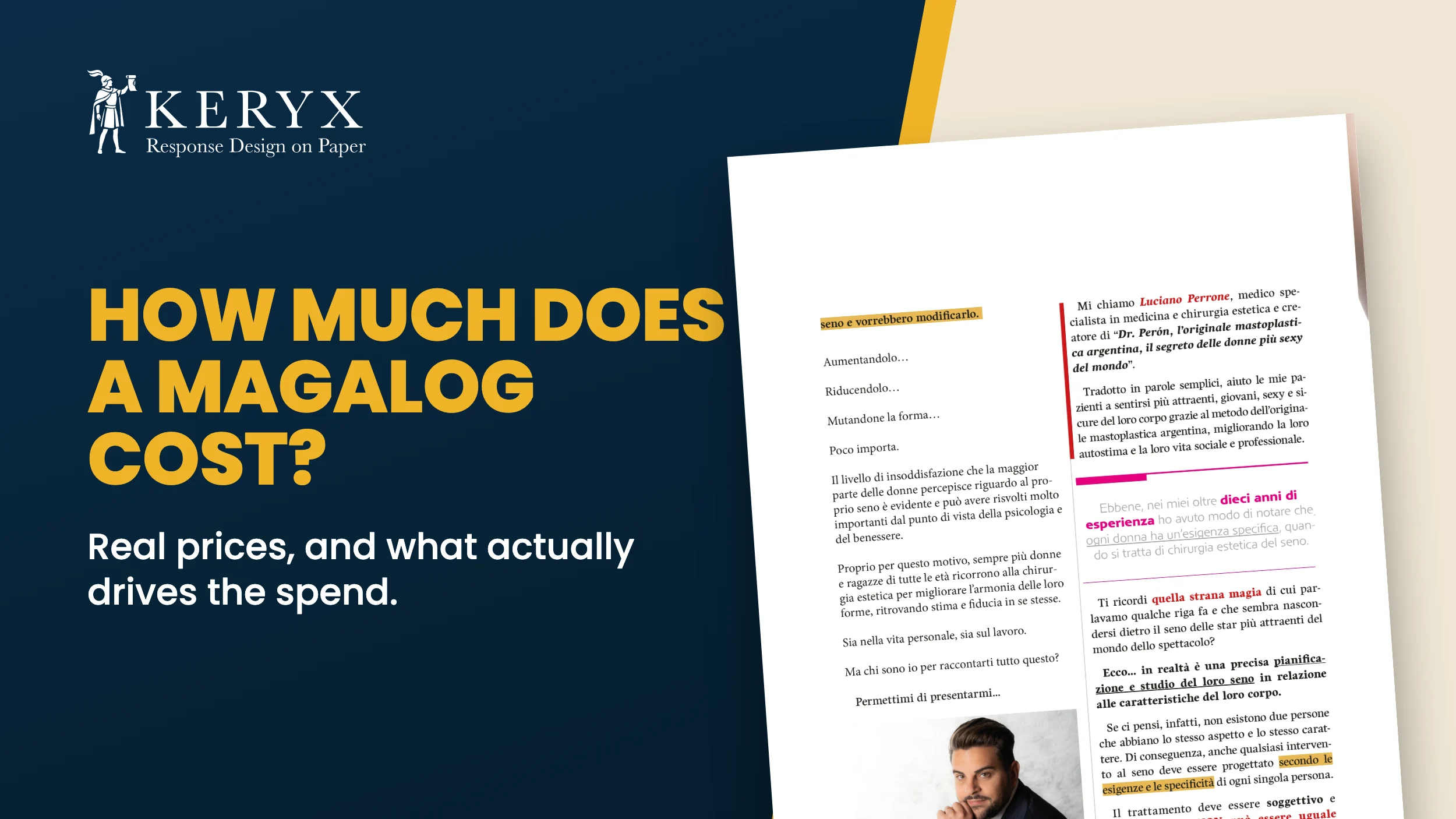
If you're reading this, you're probably one step from the printer. The copy's done, the offer is solid, and now you need to know what the finished piece costs.
Or worse: last time you already paid a designer, you printed, you mailed your list. And the piece pulled half of what the copy could have done.
Either way the question is the same. What does a magalog done right cost, and why can two quotes for "the same page count" land miles apart.
Short answer: a magalog, design and layout for clients who already have the copy, starts around $5,000 and scales with page count and structural complexity, before print. See the indicative rates on the pricing page. The exact quote depends on the project.
Long answer: the number that matters isn't the price. It's how hard that piece converts once it's in the reader's hands. And that's where the conversation changes.
If you're starting from scratch and want to understand the format first, read the full breakdown: what a magalog is, how it works, and when to use one.
The price isn't measured in pages
The reflex is to think in pages. "32 pages, what's that run me?" It's the same reflex that puts a DR designer's quote next to the local graphic designer's or a Fiverr gig.
Two different jobs.
A graphic designer lays out copy. Takes the text, puts it on the page, makes it sit nicely. A direct response designer engineers the readership path first, then lays it out. Decides where the eye lands first, where it slows down, where it hits the CTA. Decides the visual weight of the headline, the subheads, the sidebars, the callouts. Decides what the reader sees on page 3, and whether they're still reading by page 3.
That's the difference between a magalog that converts and a booklet that reads like a government pamphlet.
The point is simple. If you've put thousands into direct response copy, the real cost isn't the design. It's every conversion you lose because the reader quit too early. Against that number, the gap between a layout that pulls and one that halves your response is worth a lot more than the project fee.
What actually drives the cost
A magalog's price comes down to four things. None of them is "how pretty it looks."
1. Whether you have the copy or not. The package above is design and layout only, for clients who show up with the copy written. No copy, different job, different quote. Keep the two line items apart. Confusing "write the words" with "lay them out" is the fastest way to get a quote that doesn't hold up.
2. The real number of elements to design. Not the pages themselves, but what's inside them. How many sections, how many sidebars, how many testimonials to place, how many callouts, how many CTAs. A 32-page magalog with a multi-section architecture, testimonial blocks, and trackable QR codes is a different job from 32 pages of straight running text. That's why the work is scoped by complexity, not by a per-page rate.
3. Print and quantity. This isn't in the design price. Paper, format, print run, and postage are a separate line, and they ride on your print house and how many people you want to reach. On a direct mail campaign that line often weighs more than the design itself. Worth thinking through early, because it's the part where a mistake costs the most.
4. Expected response. This is where it all sits. A magalog that pulls even ten extra conversions over a generic layout pays for itself. If the campaign is worth tens of thousands once you add up print, postage, and potential revenue, the design isn't the line you cut. It's the line that decides whether the rest pulls.
When a magalog makes sense, and when it doesn't
I'm not going to sell you a magalog no matter what. Sometimes it's the wrong tool.
It makes sense if:
- You already have the direct response copy, written by you or your copywriter
- You sell services, consulting, courses, or high-margin products, where one extra conversion covers the spend
- You're mailing a profiled list and you need a piece that slips past the reader's defenses, not one that screams "ad"
- You've already watched a designer kill your copy and you don't want a repeat
It doesn't make sense if:
- You don't have the copy and you don't know what goes inside (copy first, then design)
- You're chasing the lowest possible price. At that point the $200 guy is your man, with the results you already know
- You need it tomorrow. Minimum turnaround is two weeks, and the bottleneck is usually the copy sign-off, not the layout
- The margin on the product is thin and the math doesn't work. Better a postcard or a smaller test before you commit to a full magalog
This is the part most vendors won't tell you. I'm telling you because a magalog printed badly and mailed to your list isn't just lost conversion. It's credibility burned with an audience you spent years building.
The proof: where the difference shows up in the numbers
A concrete one. For Bushori we designed a direct response trifold. The copywriter's words, a Keryx design built around the text. The result: one QR scan for every two brochures handed out. A 50% rate.
It wasn't the looks that pulled that number. It was the readership path. The eye walked from headline to CTA with no friction, readability put ahead of aesthetics, a piece that doesn't read like an ad and therefore gets read. The same principles run on a 32-page magalog.

Full case here: the Bushori case and the 50% scan rate.
Before you spend on a magalog
If you're not sure your current piece is pulling what it could, there are two ways to find out without committing to the full project.
First, look at the design mistakes that make people stop reading. We pulled them together in a free video on the 13 design mistakes that kill conversion. Spot three or four of them in your last piece and you already know where the response went.
Second, if you've got a campaign in the pipeline and want to talk it through with someone who maps the readership path before print, it's simple: get in touch. Bring the copy or whatever you have, and we'll work the response out before anyone touches InDesign.
No rush, no surprise quote. The copy stays yours. I don't touch a word. The job is one thing only: getting what you wrote read, start to finish.
Frequently asked questions about magalog cost
How much does a magalog cost?
A design-and-layout magalog, for clients who already have the copy, starts around $5,000 and scales with page count and structural complexity, before print, with 50% upfront and 50% on delivery. Print and postage are a separate line and depend on your print run and print house.
What determines the price of a magalog?
Four things: whether you supply the copy or not, the real number of elements to design (sections, sidebars, testimonials, CTAs, not just pages), print and quantity, and the expected response of the campaign. The price isn't a per-page rate, it's scoped by complexity.
Is a magalog worth it over a regular brochure?
Depends what you sell. A magalog earns its keep if you sell services, consulting, or high-margin products and you mail a profiled list. It's built to slip past the reader's defenses and get read like a magazine, not an ad. If the margin is thin or you don't have the copy yet, a postcard or a smaller test is the smarter call.
Why does a DR designer cost more than a freelance graphic designer?
A graphic designer lays out the text. A direct response designer engineers the readership path first, then lays it out. That's the work that decides whether the reader reaches the bottom or quits on page 3. On a campaign where you've sunk thousands into copy and print, it's the difference between a piece that pulls and one that halves your response.
Leggi questo articolo in italiano: versione italiana →